Conference for Parents at Collège Stanislas
On Tuesday, March 23, Emmanuel Royer gave a conference aimed at the parents of students at Collège Stanislas.
The oldest traces of mathematics that we know of date back three thousand years before our era. At that time, it was about measuring and sharing.
Little by little, mathematics became an abstract science, whose goal is to define and demonstrate. A pioneer of this approach was Euclid, with his Elements, three hundred years before our era.
Great Public Lecture by Sébastien Labbé
On March 12, 2023, Sébastien Labbé, as part of the International Day of Mathematics, gave a Great Public Lecture at the Centre de recherches mathématiques, a Quebec partner of the international CRM-CNRS laboratory.
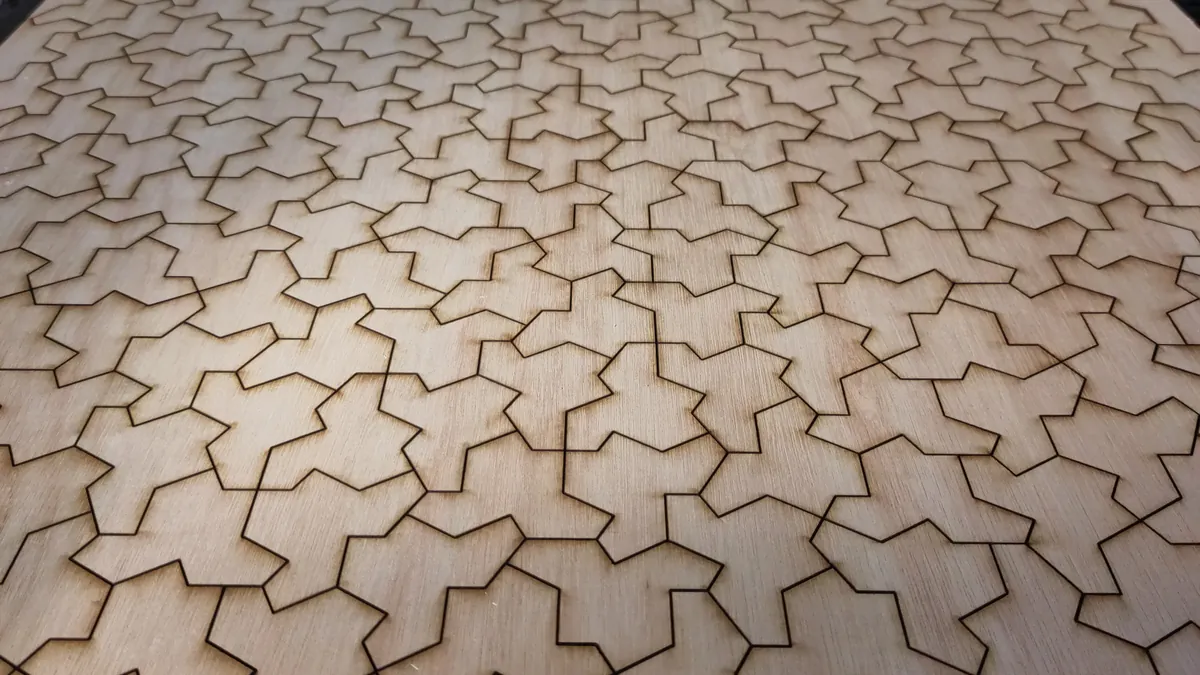
Aperiodic tilings are a vast scientific field, both in mathematics and in understanding the crystalline structure of matter. The aperiodic tilings proposed by Penrose in 1974 use two shapes of tiles, and the frequency ratio of the two types of tiles is equal to the golden ratio.
Assignment to CRM-CNRS
The Insmi has a significant number of international research laboratories. The process of assignment abroad by the CNRS allows for long-term stays, typically from six months to a year, under good conditions.
For stays starting in September 2027, it will be in the fall of 2026 that assignment requests must be submitted. Since expatriation projects need to be prepared, it is therefore possible to start thinking about them now.
The Centre de recherches mathématiques (CRM), Quebec’s partner of CRM-CNRS, covers all of mathematics in Quebec and Ottawa (in Ontario). The assignment can therefore take place in Montreal, but also in Quebec City, Ottawa, or Trois-Rivières.
Participation at IWOTA 2026
The conference IWOTA International Workshop on Operator Theory and its Applications, a satellite conference of the International Congress of Mathematicians 2026, will take place at Université Laval in Quebec from August 3 to 7, 2026.
The international research laboratory CRM-CNRS supports the conference by contributing to the funding of Philippe Thieullen, professor at Université de Bordeaux.
Support for the Saint-Flour School of Probability
Organized since 1971 by the Blaise Pascal Mathematics Laboratory (CNRS & University of Clermont-Auvergne), the Saint-Flour School of Probability has become a major annual event in probability.
This year, the international laboratory CRM-CNRS, ILR3457 is funding the participation of two young mathematicians from Canada, Robin Khanfir, a post-doctoral researcher at McGill University (Montreal, Quebec) and William Stephenson, a doctoral student at the University of Ottawa (Ontario).
The CRM-CNRS welcomes Richard Griffon for a long stay
Starting from February 1, 2026, and for six months, the CRM-CNRS welcomes Richard Griffon.
Richard GRIFFON
Lecturer, University of Clermont-Auvergne
02/01/2026 – 08/31/2026
Richard Griffon has been a lecturer at the University of Clermont Auvergne since January 2021. His work lies at the intersection of number theory and Diophantine geometry. It mainly focuses on the arithmetic of elliptic curves and abelian varieties over function fields, the asymptotic study of special values of their L-functions, in the spirit of the Brauer–Siegel theorem and its generalizations, as well as on isogenies between abelian varieties and their interactions with various notions of height. He defended his thesis in July 2016 at the University of Paris Diderot, under the supervision of Marc Hindry, on analogues of the Brauer–Siegel theorem for families of elliptic curves defined over function fields. After his thesis, he was a postdoctoral researcher at Universiteit Leiden, then at Universität Basel. He is notably a member of the GAEC (ANR) and PadLEfAn (ANR) projects, and of the international network IRN GandA (CNRS).
International Laboratory Network of the Americas
On January 26, 2026, the Jean-Christophe Yoccoz International Laboratory in Rio de Janeiro celebrated its twentieth anniversary in the presence of Eric Tallon, Consul General of France in Rio de Janeiro, Antoine Petit, CEO of the CNRS, Marcelo Viana, director of the Instituto de Matemática Pura e Aplicada, Impa, and Christophe Besse, director of the National Institute of Mathematical Sciences and Their Interactions, CNRS-mathematics.

On this occasion, the MATHAM research federation was inaugurated, bringing together international research laboratories in mathematics in the Americas. The following laboratories are currently part of it:
Infinity and Paradoxes: An Open Door to Mathematics

On Wednesday, January 21, Didier Lesesvre gave a presentation to the students of Collège Stanislas in Montreal. He spoke to the students about what mathematical research is and explored foundational paradoxes in the history of mathematics, showing how they led to reflections on the concept of infinity and then to working with it.
Find the entire series of popularization conferences in mathematics offered by CRM-CNRS at Collège Stanislas (French institution of the AEFE network) for the 2025-2026 academic year.
Support Franco-Quebec Mathematical Research
“We are always trying to find out what mathematics can be useful for while forgetting that sometimes, being useless is mainly serving the future.”
Bruno Bonell, Secretary General for Investment, in charge of the France 2030 plan.
International cooperation is fundamental in sciences in general, and in mathematics in particular. The CNRS Foundation contributes to the development and promotion of the CNRS, a French public multidisciplinary research organization.
To specifically support Franco-Quebec cooperation in mathematics, do not hesitate to go through the Foundation!
From Fermat's Little Theorem to the Notion of Group
On Wednesday, January 14, Emmanuel Royer gave a presentation to the final year students of Collège Stanislas in Montreal on Fermat’s little theorem and the notion of group, an introduction to a series that will take place on February 4, during which RSA cryptography and elliptic curve cryptography will be discussed.
Every prime number unfailingly measures one of the powers -1 of some progression, and the exponent of the said power is a sub-multiple of the given prime number -1 (…). I would send you the proof, if I were not apprehensive of being too lengthy.
Pierre de Fermat, October 18, 1640.