The CRM-CNRS Hosts the Mathematics Directorate of CNRS
The mission of the CRM-CNRS, an international research laboratory in mathematics resulting from a partnership between the CNRS in France and the Centre de recherches mathématiques in Quebec, is simple yet ambitious: to develop relationships between France and Quebec in all areas of mathematics. On a daily basis, mathematicians from France based in the laboratory in Montreal invent and discover new mathematics with their colleagues from Quebec.
The life of the laboratory also involves regularly meeting the women and men who enable these discoveries and inventions by working to animate and coordinate mathematics. Thus, the CRM-CNRS had the honor of receiving earlier this week Professor Christophe BESSE, director of the Institut national des sciences mathématiques et de leurs interactions, and his deputy scientific director in charge of Europe and international affairs, Professor Frédéric HÉRAU, accompanied by Andréa DESSEN, director of the CNRS office in Canada, and Suzie BRONNER, her cooperation officer.
Two and a half days of intense meetings filled with institutional and diplomatic exchanges, and since science is at the heart of the action, scientific discussions before the Insmi leadership joined the international unit on the Canadian Pacific coast, the PIMS in Vancouver.
All the institutional partners of the CRM were invited to discussions, and we had the pleasure of meeting:
- the vice-rectorate for research, creation, and innovation of Université Laval, led by Professor Eugénie BROUILLET;
- the vice-rectorate for research, creation, and dissemination of Université du Québec à Montréal, led by Professor Lucie MÉNARD;
- the vice-rectorate for research (science and technology) of Université de Montréal, led by Professor Luc STAFFORD.
These meetings allowed us to consider amplifying relationships with these partners and to outline the beginnings of a future collaboration.
In addition to these meetings with institutional partners, there was an exchange with an academic partner in Ontario, Université d’Ottawa, led by the associate vice-rector for research promotion and development, Professor Martine LAGACÉ.
The Fonds de recherche du Québec is an essential supporter of exchanges between France and Quebec. We had the honor of meeting with Janice Bailey, Vice-President for Research – Scientific Direction, Nature and Technologies sector of the FRQ.
The Centre de recherches mathématiques, Quebec partner of the CRM-CNRS, has a dual activity: a conference organization center on one hand, and a research center in mathematics on the other. This latter activity is organized into thirteen laboratories covering a very wide spectrum of mathematical science. The Insmi leadership exchanged with the directors of these laboratories, who presented their activities, their links with France, and shared what they identify as obstacles to collaboration or possible avenues for evolution.
A time was dedicated to a dialogue with representatives of the French community in Quebec, including:
- Émilie OIVIERI, undergraduate student in mathematics at Université McGill;
- Adrien SEGOVIA, PhD student at Université du Québec à Montréal;
- Quentin LABRIET, post-doctoral researcher at Université de Montréal;
- Henri DARMON and Jean-Christophe NAVE, professors at Université McGill.
Finally, while the academic year 2025-2026 has only just begun two months ago, exchanges between the Insmi leadership and that of the CRM-CNRS have started regarding the 2026-2027 project, particularly concerning the French scientists to be welcomed after September 2026.
Tuesday afternoon was dedicated to scientific presentations by mathematicians from France assigned by the CNRS to the CRM-CNRS. The titles and summaries of the presentations are given below, followed by discussions on the assignment process.
The visit concluded Wednesday morning with a reception organized at the Residence of France, at the invitation of the Consul General of France in Montreal. This reception was attended by:
- Camille PAULY, deputy consul general and cultural cooperation and action advisor;
- Nicolas DOUAY, scientific and university cooperation attaché;
- Noé BOLOT, scientific mission officer;
- Canan TURKKAN, university mission officer;
- Annie BOUTHILLETTE, executive director of institutional relations at École de technologie supérieure in Montreal (ÉTS);
- Philippe-Edwin BELANGER, director of the graduate studies and student success service at the Institut national de la recherche scientifique (INRS);
- Christophe BESSE;
- Frédéric HÉRAU;
- Andréa DESSEN;
- Suzie BRONNER;
- Franco SALIOLA, director of the Centre de recherches mathématiques;
- Emmanuel ROYER, director of the CRM-CNRS.
This reception allowed for very interesting discussions with ÉTS and INRS.
Scientific Presentations from Tuesday Afternoon
Sébastien Labbé
Recent Results on Aperiodic Tiling
While aperiodic tilings known since the 1960s are often related to the golden ratio (Penrose tilings, Ammann tilings, Jeandel-Rao tilings, tilings by the aperiodic monotile discovered in 2023), we present a family of aperiodic tilings associated with metallic numbers, that is, the positive roots of the polynomials $x^2 - nx - 1$ for any integer $n \geq 1$.
Lucile Devin
Vertical Distribution of Zeros of $L$ Functions in a Family of Twisted Elliptic Curves with Complex Multiplication
In collaboration with Chantal David, Alessandro Fazzari, and Ezra Waxman, we are interested in the distribution of zeros of $L$ functions associated with elliptic curves having complex multiplication. Our study is placed within the broader framework of the Katz and Sarnak conjecture on the vertical distribution of zeros of $L$ functions in families, which allows in particular to bound the average rank of our elliptic curves.
Marc-Hubert Nicole
A Non-Archimedean Ax-Lindemann Theorem for Certain Higher-Dimensional Shimura Varieties
The Ax-Lindemann theorem is a result of functional transcendence for the classical exponential function. It describes the maximal complex algebraic subvarieties of the inverse image, with respect to the exponential map, of an algebraic subvariety of the product of pointed complex planes: these are the translates of rational linear subspaces.
In the context of Shimura varieties, one can replace the exponential function with their complex uniformization and obtain an analogous description of the maximal algebraic subvarieties.
In this talk, we consider the $p$-adic uniformization of higher-dimensional Shimura varieties via Drinfeld symmetric spaces and obtain a non-Archimedean Ax-Lindemann type statement (work in progress with Jackson Morrow and Giovanni Rosso).
Claire Guerrier
Modeling Fungal Growth at the Molecular Level: Combining PDEs on a Graph and a Coalescence Process
Filamentous fungi constitute a kingdom comprising millions of species that primarily grow in the form of filamentous networks in the soil. They are composed of digitiform extensions called hyphae, which can branch at their tips or upstream, and fuse to form networks of thousands of connected hyphae.
While a typical hypha measures a few micrometers wide (and can be much thinner), entire networks extend from a few millimeters to several centimeters, or even kilometers in nature.
To colonize and digest their environment, fungi produce enzymes and secondary metabolites currently used in the pharmaceutical industry. Recent research suggests that they could also be employed for soil decontamination, sustainable agriculture, and energy storage.
All these remarkable applications require controlling the growth of the network and understanding how to constrain the fungus to produce the enzyme or substance of interest.
In this talk, I will present our approach to controlling fungal growth and production. By modeling at the molecular level, we combine the growth of hyphae — represented by partial differential equations evolving on a graph — and the branching of hyphae — represented by a coalescence process — to directly link the evolution of the network to environmental conditions.
These models form the basis of a larger-scale model describing the growth of the complete network, guided by molecular mechanisms and validated using data from our experimental collaborations.
Nicolas Crampé
Leonard Pairs: Uses and Generalizations
I will present Leonard pairs with various applications in theoretical physics, algebraic combinatorics, or representation theory. The different generalizations I am interested in will be introduced.
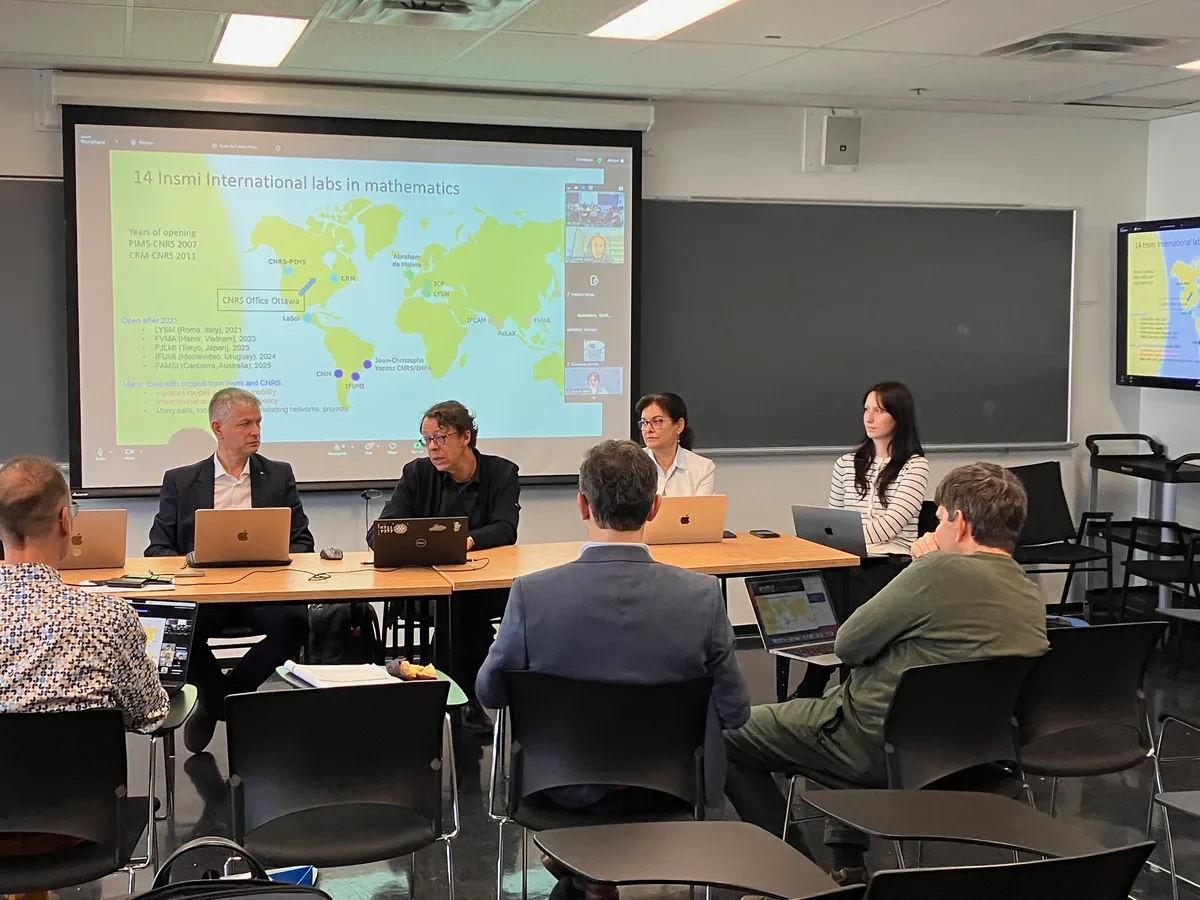
Sébastien Labbé is a research officer at CNRS assigned to CRM-CNRS.
Hosted on delegation by the CNRS for a long-term stay at CRM-CNRS, Lucile Devin is a lecturer at Université de Littoral Côte d’Opale.
Hosted on delegation by the CNRS for a long-term stay at CRM-CNRS, Marc-Hubert Nicole is a professor at Université de Caen Normandie.
Claire Guerrier is a research officer at CNRS, assigned to the Laboratoire Jean-Alexandre Dieudonné (Université de la Côte d’Azur & CNRS), hosted on a long-term mission at CRM-CNRS.
Nicolas Crampé is a research director at CNRS assigned to CRM-CNRS.